

Goodbye two by two. Hello two by nothing.
A framework for building distinctive brands

A common brand strategy framework is the perceptual map. It’s a two by two matrix that organizes where your brand is perceived to be positioned along two dimensions. Perceptual maps are a great way to identify a gap in the market (to be filled by your brand, obviously) and/or diagnose what needs to change in order to have a more competitive positioning.

However, when it comes to inspiring truly differentiated brands, the best framework isn’t a two by two. It’s a two by nothing, where your competitors fight over one axis, and you’re not on the map at all. Let me explain.
A two by two shows how your brand fares in the combination of two desired dimensions on the market. Cheap AND high quality. Excellent. That’s good market positioning, sure. But if you’re looking for a differentiated brand positioning, an idea that can own a role in culture and inspire differentiated marketing in a crowded category — you don’t want to convey how your brand sits at the combination of features other brands also offer. You want to show the world (or at least your creative team) that your brand is different. It’s in a category all on its own. It’s not just ‘the high quality version’ of something that already exists. It’s a new category altogether.
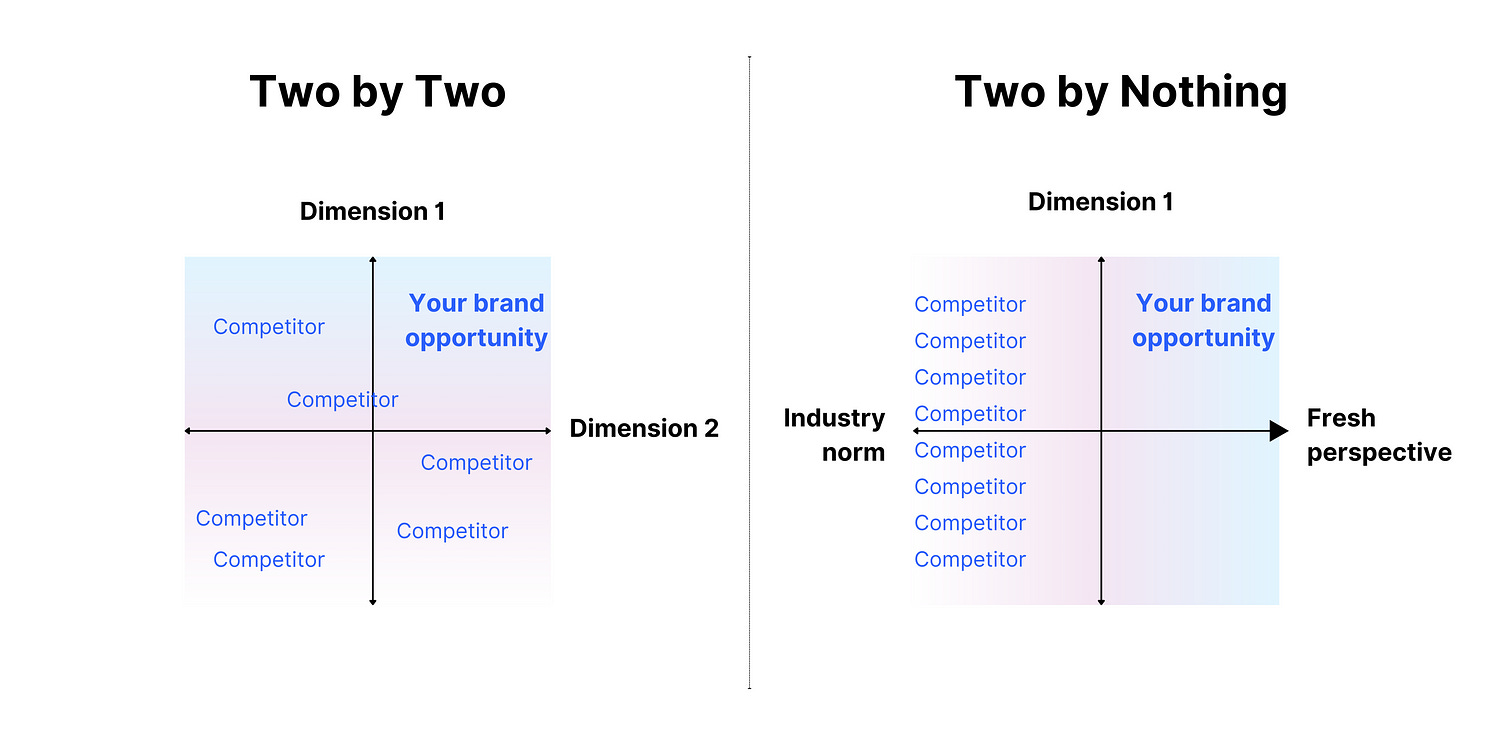
The Two by Nothing takes all your competitors and shows what they are fighting over — price, quality, etc… and then reveals that you are playing another game altogether.
Take places to stay and Airbnb. A typical perceptual map might look like this:
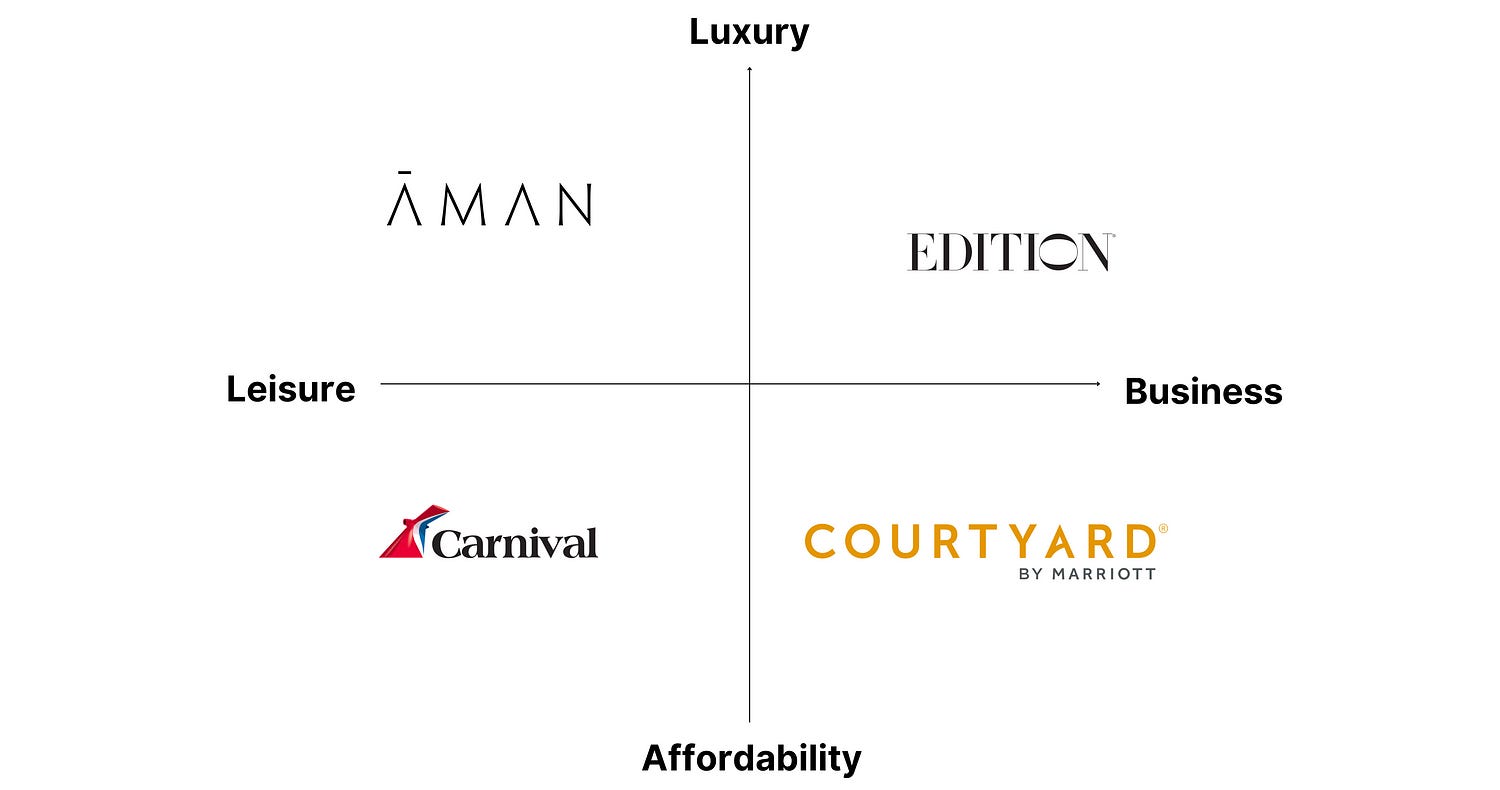
If you were to add in Airbnb, it would likely be somewhere on the left side. Accurate? Yes. Informing? Also yes. Inspiring for standout marketing? No. But if you start from the assumption of a Two by Nothing, your challenge shifts from How do we show that Airbnb is the best combination on the market? To, How do we position Airbnb on a new plane altogether?
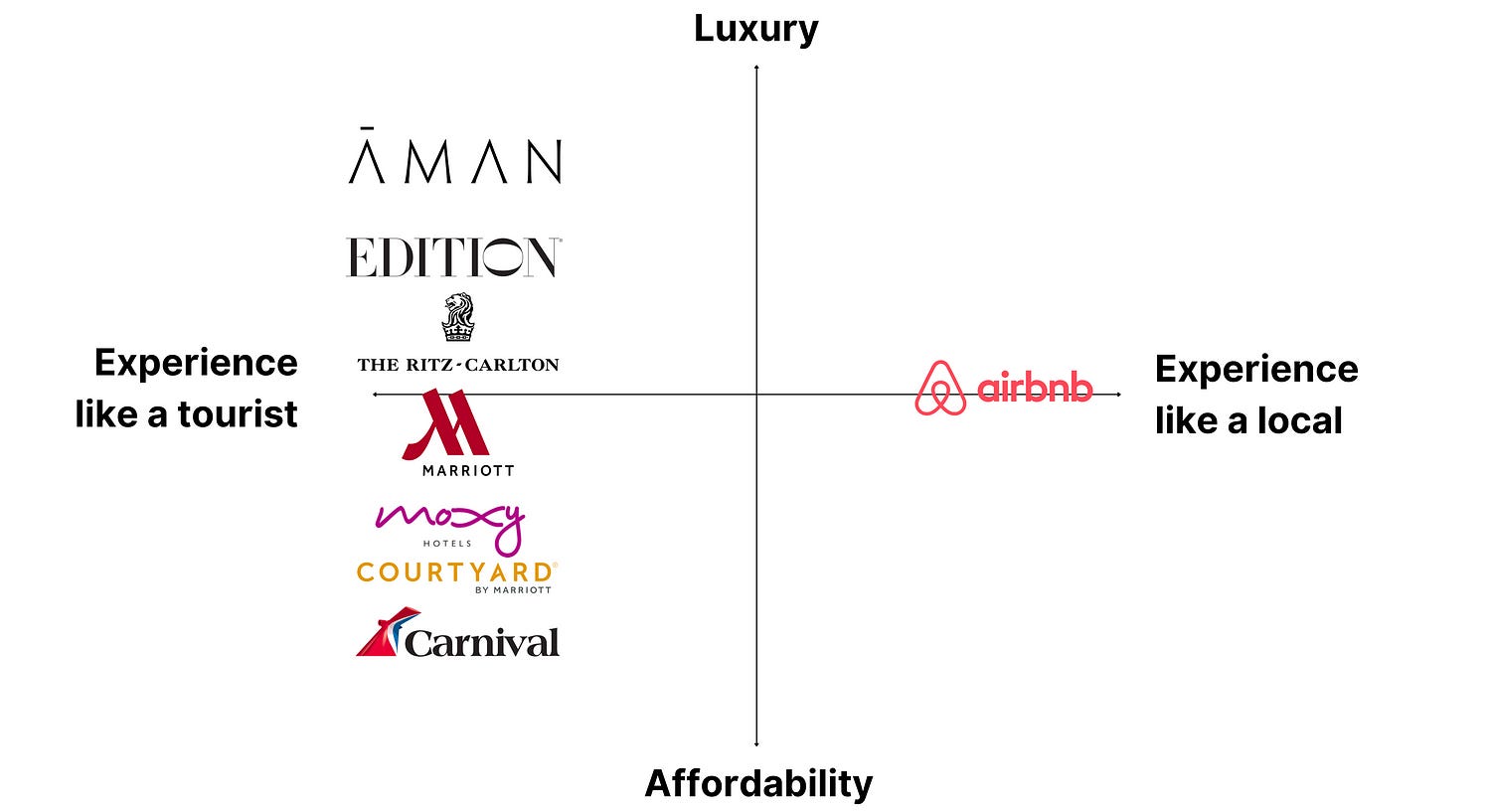
Suddenly. Airbnb isn’t just a place to stay. It’s a way to experience a new place. Airbnb’s Chef’s Kitchens campaign is rooted in the idea that an Airbnb is a completely fresh experience:
Airbnb’s Chef’s campaign aims to convey Airbnb as the best way to travel with friends. You could easily position all hotels and cruise lines along a horizontal dimension that goes from separate rooms to stay together (with Airbnb as the sole brand in the stay together category).
Airbnb doubled down on this benefit (the best way to travel with friends) in a new campaign, that groups all hotel rooms together, with Airbnb as the unique (and better) option for group travel by way of more space:
In both cases, Airbnb isn't being positioned as better, it's being positioned as different in kind. That's the Two by Nothing at work
In essence, the Two by Nothing is a way to raise the bar for your marketing. It’s not enough to be better on one metric. A standout brand requires rethinking the category altogether.
How do you create a two by nothing for your brand?
1. Map the competition
Like the typical perceptual map process, start with researching the market. Identify your top competitors and substitutes. What features do they provide? Why do people use them? How do customers evaluate options? What are the important differentiators? You can segment your competition many ways — price, features, healthiness, seriousness, taste, style, usage occasion and start to score them.
2. Uncover insights around your brand and audience
Interview your brands’ founders, executives, marketers, product managers, customers, and front line workers. How do they describe the company? Your mission? Your products? There are a lot of creative questions that can help get to the root of your brand and your audiences’ needs. What do employees believe? Why did the founder create said organization? If your brand was to organize a protest, what would be the subject? The goal here is to start to understand how your brand or company can be positioned separately from others.
It’s possible your company isn’t doing anything that different from other brands in the category from a pure product perspective. That’s okay. One can differentiate through marketing and values. Look at Liquid Death. It’s ‘just’ water, but their marketing, packaging, and values convey something akin to an energy drink. Corona isn’t a beer; it’s a vacation in a bottle.
3. Position your brand on a new plane to your competition
Here is what you start to think laterally. What do all companies in the category have in common? What are the industry norms that people do not even think about anymore, because they are so ingrained? E.g. All hotel rooms must be standardized. All Swiss timepieces are expensive, rigid devices. All flip flops are flimsy and designed for the beach. Cross these assumptions with that you learned in step 2. Somewhere in that tension is usually your opportunity to reframe the category.
A few ways to pressure-test whether you’ve found a 2 by Nothing axis:
Does it change what you’re competing on, or just how well you compete? “Higher quality” is not a Two by Nothing. “Not a timepiece — a fashion accessory” is. The new plane should make your old competitors irrelevant, not just inferior.
Does your audience care? A reframe only works if it maps to something people actually care about. Swatch’s “fashion accessory” framing landed because people wanted a watch that expressed personality. Airbnb tapped into insights into what makes a great trip. If the new plane is true to your brand but invisible to your customer, it’s a strategy document, not a brand builder.
Can you build years of marketing off it? One clever campaign isn’t a positioning. Ask whether the reframe can sustain a product line, a visual identity, a community. Liquid Death’s irreverent and rebellious reframing of water has powered merch, collabs, and ads for years.
If your product isn’t doing anything genuinely different — which is many products — the reframe will come from values or identity rather than features. That’s not a cop-out. Corona is beer. Liquid Death is water. The category reframe is the product.
Once you find it, place all your competition on one side, and choose a horizontal axis that demonstrates that your offering is something completely new. A Swatch isn’t a rigid timepiece, it’s a flexible fashion accessory. A Corona isn’t a beer. It’s a beach in a bottle.
The best way to test this framework is to try it on a brand you know well, or your own. If you're working through a positioning problem right now and want a second set of eyes, my inbox is open.
Great post, thank you! Liquid Death example is the most interesting to me. It's water, that's it. They figured out though that every other water brand was fighting over the same axis: purity, mountain springs, hydration etc. and just opted out of that entire conversation. Now they're selling merch and doing collabs like they're an energy drink company. Most marketing teams would never get there though. The instinct is always to play on the same map as everyone else and just argue you're better at it. Walking away from the map entirely takes a kind of confidence that's pretty rare in practice.
The framework is sharp. The Two by Nothing creates attention and differentiation but it doesn't create a margin structure. Liquid Death repositioned water as rebellion. Brilliant marketing. Underneath it, they're still selling water with water economics and they had to raise over $700M to sustain the performance. Corona owns 'beach in a bottle' and it works because the underlying product economics already supported the positioning. The brands I autopsy almost always had a great Two by Nothing. They were genuinely different. What killed them was that being different didn't change the unit economics of the category they were still operating in. The positioning was new. The cost structure was the same as everyone else's.