

Building the nation's largest soccer league
Tarek Pertew shares the operating principles behind growing a neighborhood soccer league into a national business

Eight months ago, someone invited me to join their recreational soccer team. I immediately declined; I’d never played on a sports team and I saw no reason to start embarrassing myself in one now.
“Please join! We’re required to have women on the field at all times,” he said. “And it’s fun!”
He was a captain in NYC Footy, a rec league built around mixed-gender teams and a strong sense of community. The requirement was enough to convince me to try. Eight months later, I’m starting my fifth league and telling newcomers what to expect.
I’m not the only one. NYC Mayor Zohran Mamdani joined NYC Footy as a free agent in his 20s, becoming captain of his team LIRR FC within a year of joining.
NYC Footy is cheaper than therapy.
- Zohran Mamdani
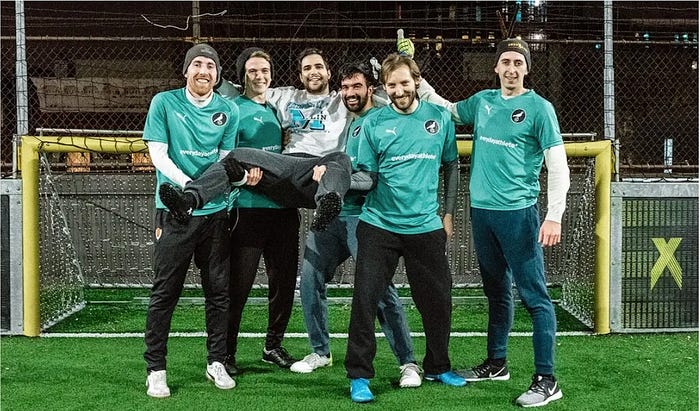
Community has become one of the most overused words in business. Every brand wants one. Investors ask about them. Yet few organizations figure out how to build one that scales without becoming impersonal, or how to turn one into a business at all.
Serial entrepreneur Tarek Pertew founded NYC Footy as a side project in 2011, and began scaling it into The Footy League in 2021. Today it’s the largest organized adult soccer league in the country.
I reached out to Pertew to learn about building Footy into a brand, designing for a wide audience of soccer newbies and experienced players alike, and scaling the oft unscalable notion of “community.”

What follows is a lightly edited, condensed transcript of our conversation.
In this interview:
Pertew’s view on how to scale community and why many brands fail there
Why brand positioning follows your actions, not the other way around
How to compete with well-funded rivals? Out-service them
The one marketing channel Pertew would keep if he had to kill the rest
How Pertew would build soccer culture in India: a country of 1.4 billion with no World Cup team
Michelle Wiles: Tell me about yourself: what do you do, and what’s the unfair advantage you bring to it?
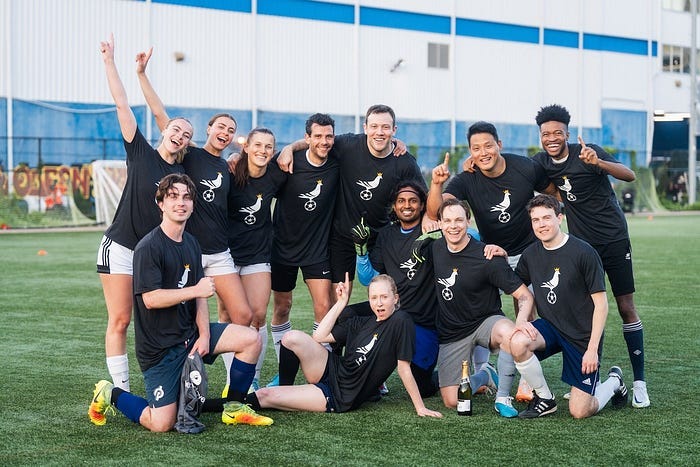
Tarek Pertew: I run The Footy League, the biggest organized adult soccer league in the country. Not pickup, not a Meetup group, real leagues, real teams, real seasons, across all five boroughs in NYC and, recently, in new markets across the country, including Miami, Dallas, Tampa Bay and New Jersey.

My unfair advantage is that most leagues have a dated and analog approach to operations. I come from a tech and media background, which taught me the power of investing in media and scalable processes.
Additionally, I’m a player in my own league, so I have a very intimate understanding of the player experience. I know what it feels like to be new to a city. What it feels like to be unsure if you’ll make a fool of yourself by committing to a team sport.
Most communities never become businesses. What did you get right that made Footy expand from a community into a business?
I’m so glad you’re asking this, because one of my biggest regrets about how capitalism works is that so many wonderful communities eventually fade or fail to grow because they cannot figure out a sustainable business model.
For me, it wasn’t clear this could be a full time, real career investment until 2021 when the demand for organized leagues (NYC Footy in particular) was so overwhelming that the wheels nearly came off of the operation. Fortunately, I was coming off the back of selling my media tech company and I could focus all of my energy into hiring and putting processes and systems in place that could catch up with the demand and put us in a position to expand.
In short, we built real operations underneath the community feeling: real registration systems, real field and referee logistics, procurement practices that reduce expenses, a media framework attractive to sponsors, all while investing in customer service practices that keep the experience feeling local and real.
We built real operations underneath the community feeling.
That last bit is important, because it means we don’t lose sight of what it feels like to be a player at any level. Part of our value is for the ex-college player who misses competition. But so much of what we offer is for someone who’s never touched a ball and just wants in.
Your requirement of women on every team is what got me — someone who had never touched a ball — to join. It’s great for inclusivity, but it requires recruiting. What made you decide to hold onto this requirement?
Because inclusive is inclusive. You either mean it or you don’t. Trust me, it would be easier and, at least in the short term, more lucrative to drop the requirement.
For us, moving away from mixed leagues moves us further from “community first” and more towards “soccer first” which I think is where many leagues fall short. Community, not competition, is why people stick around.
Community, not competition, is why people stick around.
True inclusivity, a widely overused term that I almost hesitate to spell out, will attract people from all backgrounds by definition. And that creates a more interesting and fulfilling community to be part of. It increases the likelihood of finding friendship AND love.
Volo recently bought Zog to build a PE-backed national roll-up of exactly your category. You’re going national too, but organically, city by city. How does Footy’s strategy differ from the roll-up model? What advice would you give a founder competing against a PE-backed competitor?
Volo and Zog rolling up means less flavor, less local grip, more standardized product across more cities managed from further away. I know Volo’s leadership and I like them. We operate one sport. Imagine operating dozens? I can’t imagine how complex that must be.
It requires really strong leadership to pull off and clearly that attracted the “money guys”. But that opportunity invites risk: you can lose sight of a community-first approach and your value rolls up almost exclusively in dollars and cents. That said, this type of business is extraordinarily difficult to build. It has the types of diseconomies of scale that take serious brain and brawn to overcome. PE can help with that by bringing in sophisticated minds and resources. That’s a fine model, it’s just not ours.
My advice to a founder facing a capitalized roll-up, particularly a service business, is out-service them. As a customer of a service business, you can “feel” when there’s new ownership, when a company goes ‘corporate.’ This is where you can compete. That feeling is what keeps people from ever comparison-shopping you against a bigger, better-funded option.
My advice to a founder facing a capitalized roll-up, particularly a service business, is out-service them.
You’re also expanding categories. You have the league, coaching company BetterPlayer and apparel brand Paloma. Why did you decide to do a separate brand for each instead of one parent brand?
They’re genuinely different offerings, so I wanted them to be able to move independently instead of being tied to whatever’s happening with the core brand. If The Footy League has a rough season in one market, that shouldn’t slow down Paloma or BetterPlayer, and vice versa.
Separate brands also mean I can take capital into one business without it touching the others, expand each into different markets on its own timeline, and let each one run whatever business model actually fits it instead of forcing everything into the league’s model. That matters most with BetterPlayer. It’s not a soccer product, it’s a platform that is designed to help anyone get better at any sport. As their own brands, they can go anywhere.
That said, they all serve each other, which is why it’s possible to operate them as a collective. And since we do have a 20 year plan, we aren’t focused on any one of these brands just exploding onto the scene. All in due time…
Like any great brand, Footy has a strong set of values: Lead with Kindness, Be Inclusive, Call It In, Keep It Clean. How do you operationalize these when you’re adding thousands of members?
Values only matter if they show up in the boring stuff. Ours live in how captains are onboarded, how referees are trained, et cetera.
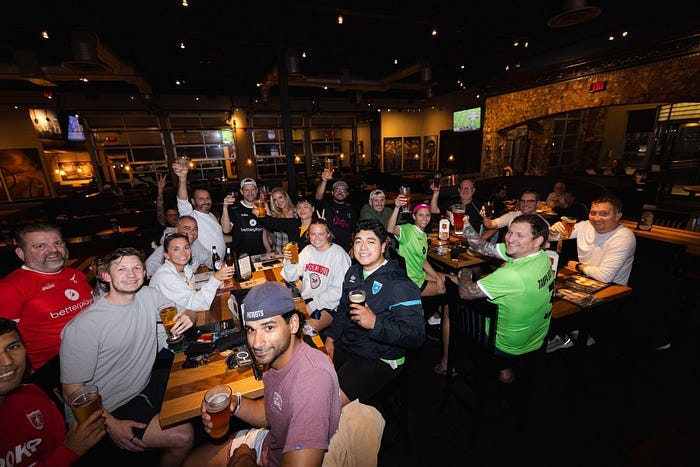
By making them public, it means the community can embrace them and hold themselves (and others) accountable as well. So much of what makes this community so amazing is how other community members reinforce these values. Plus these values only count if they survive contact with tens of thousands of people who never read the website.
Values only matter if they show up in the boring stuff.
Additionally, we have a broader set of values that governs how we build the business. These core values are what we regularly refer to when we have to make difficult decisions.
Let’s talk about your marketing. If you had to kill every one of your marketing channels but one, what survives?
As of this exact second, newsletter marketing. It reigns king in terms of most successfully reaching our most committed community members with the relevant info.
Otherwise, it’s good, old fashioned, word of mouth. We’re not in a rush, so we can build a great product and let the people do the selling work for us. Plus, paid channels get people to try us once. The community is what makes them stay and bring more people.
Paid channels get people to try us once. The community is what makes them bring more people.
Which company’s marketing are you most jealous of right now, and why?
In terms of the space we operate in (soccer), I’ve been impressed with a relatively new outfit hailing from Austin called Vanta Athletics. The visuals behind what they’re building in the soccer venue space is unrivaled.

Outside of the category, I’d say it’s fair to say that I envy just how amazing the Humans of New York (HONY) media is and how successfully they engaged an audience to connect more deeply.
We have a community of amazing humans. I hope, one day, we can build on that approach to learn more about the faces of Footy.
If you could wave a magic wand and add one skillset to your marketing team, what would it be?
Geez. There’s a lot actually. But if I could wave a magic wand today, it would be someone that is an absolute pro at technical email marketing. Smart segmentation and automation. Strategic, inviting and friendly touchpoints that nurture users into the community.
If I could have two, the second would be someone that can crush a multi-channel marketing approach on social. Someone that can build and syndicate content that performs on all media platforms (not just Instagram, which is our current bread and butter).
What’s something you read or watched that changed how you think about business?
One of my favorite books is The Count of Monte Cristo, which I’ve read nearly 10 times. One of the takeaways is how important clear, commanding communication is in building confidence and trust and ultimately persuading people (and a community) that your vision is sound.
Also, in our effort to understand how to best expand our operations outside of NYC, the film “The Founder,” with Michael Keaton on scaling McDonald’s made it crystal clear how important finding the right profile of person is when you are entrusting your vision to others.
India has 1.4 billion people and no World Cup team. If someone hired you to build soccer culture there from scratch, where would you start?
I’d borrow from the playbook of cultures that have been successful (e.g. Iceland) and begin with a small, well connected community and expand from there until, like TFL, the culture spreads through the community.
Simultaneously, I’d invest in infrastructure so that the sport is infinitely accessible anywhere and everywhere within this subset of the broader nation.
Third, I’d scout promising talent and ensure they are receiving the training and development they need to maximize their capability, which is such a powerful marketing tool for the younger generation that looks towards leaders. Look how far Egypt, Norway, Portugal, etc. have come when their heroes have carved a path.
You don’t get a World Cup team out of a country that doesn’t have a soccer culture. You build the culture first by making the sport a normal, fun and accessible thing anyone can do on a Tuesday night, and the talent pipeline follows because now there are millions more kids growing up in households where soccer is already part of life.
Everything you’ve described — the inclusivity rule you won’t break, the emphasis on player experience, your focus on community over competition — sounds like brand building without ever using the word. What do most people get wrong about ‘brand’?
They think the brand is the logo, the colors, the Instagram grid. Brand is actually the experience someone has the first time they show up to a field alone, not knowing anyone, and how included they feel by halftime.
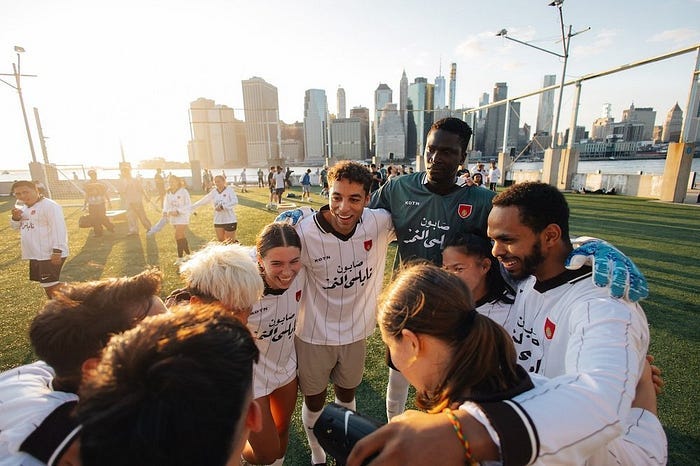
In that case, The Footy League has one of the strongest brands in soccer.
If you’re curious about what a great community-led brand looks like, or want to take a shot on the soccer pitch yourself, sign up for a league.
How would you grow The Footy League further?